
The Differences Between Weekly PDR Training Courses

So you are thinking about paintless dent repair / removal PDR training? Did you know it takes more than 1-2 weeks just to understand what PDR is really about? Take a look at our curriculum. A lot to cover huh? We offer 4 weeks of pdr training and we'll be quite honest, you still won't know everything. If I did say you would know everything, than I would be telling you what you want to hear, but instead.. I'd rather tell you the truth.

What's the pdr training curriculum like? 

We start with the basics by covering tool usages and theories. Moving into basic ding removal, glue pulling, heat usage and eventually big dent removals. Grasping these lessons take time to learn and develop. Dent Time believes giving the student 4 weeks not only develops good habits but increases your learning curve dramatically. Here is our curriculum so now you have something to compare when deciding what school to attend. Although it is possible to show these techniques in a week or so but unfortunately there is not enough time for a student to absorb what was taught.

What's the difference between the 2, 3 and 4 weeks training curriculum?

Well for one thing is time. Our 2 week program does cover most of the topics but it does not allow as many advanced dent repair techniques.

Every student is different.

PDR training is not suppose to be trained in groups. It should be one on one and that is it. As we train a student, their progress depends on how well they understand the technique. But that is where we come in. Every student is different and so is our training. Our goal is to always make sure our students understand that it's not always about the size of the dent repair, it's about the quality of the dent repair. Once our student builds a good work habit with common door dings, he or she is moved on to the next lesson. We do not move a student up in lessons if they do not have or keep a good work technique and habit. Each step builds the foundation for the next lesson and helps ensure a solid and structured habit core. If we jumped from one lesson to the next without structure, then a student would become confused, frustrated and loose their motivation.

Our training curriculum is designed around the student, not the instructor. It's important to realize that if you don't succeed, we don't succeed.
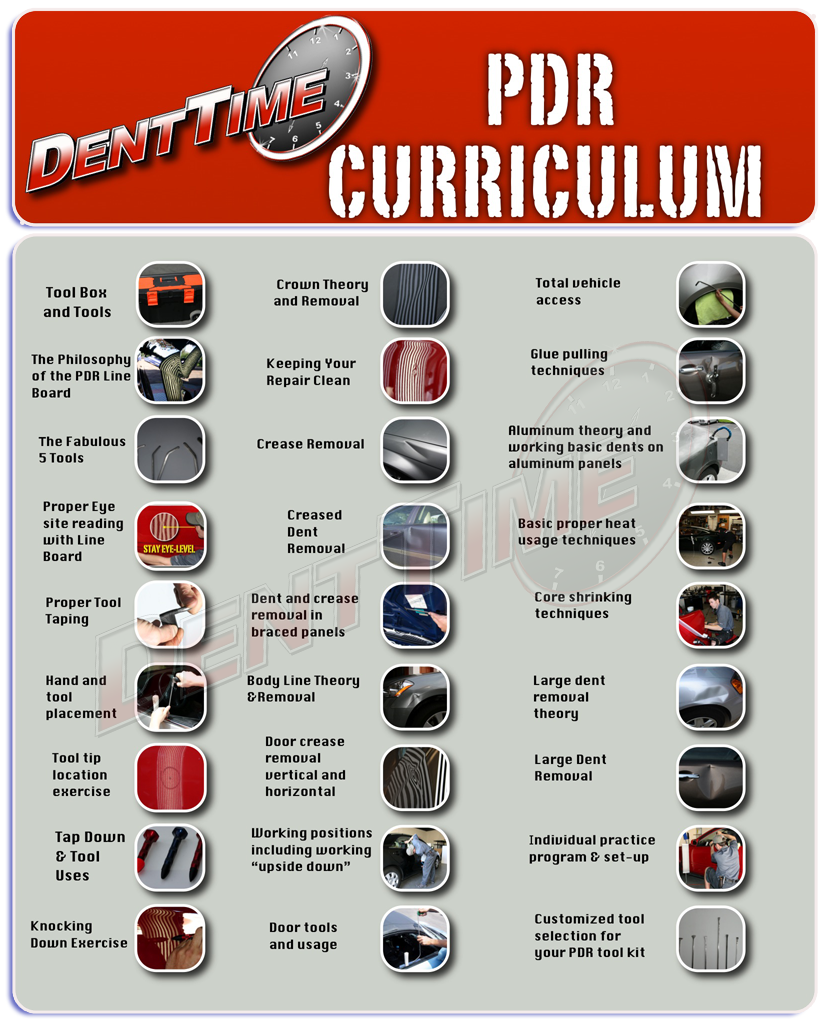
paintless dent removal / repair curriculum - dent time

Training Details

The Ding Removal Process is the combined techniques that you have learned up to this lesson. Finding your tip, reading the line board, taping down will all play it's own part when it comes to removing dings and dents. Although this is one of the most challenging parts of our pdr training course, you'll be taught with good habits. Soon, you'll develop pin point pressure, eye-hand coordination and muscle memory.

paintless dent repair / removal trainingBefore you can walk, you must learn how to crawl first as they say. That's exactly what we demonstrate during our pdr training curriculum. You'll have to learn how to tap down before you can actually push a dent. This technique is commonly known as a knocking or tapping down. Not for just for the sole purpose of correcting mistakes but simple for releasing pressure and keeping the paint flexible as well.

Knocking down is just as important as pushing a dent. That's why you'll get plenty of practice to perfect a developing good habit when it comes to learning the tap down technique. 


eye level paintless dent repair removal trainingStaying Eye Level - This chapter trains you to stay honest and practice good habit by always looking eye level across the dent. During your training, you'll see and understand why it's so important to work your dent and finish at eye level.

paintless dent repair training crown removal Crown Removal & Theories - In almost every dent repair, you'll experience crowns or trapped pressure around the dent. This part of the PDR training course develops your eye sight to become more acute and recognize characteristics when it comes to locked pressure and crowns.

pdr training tool application Tool Applications - Understanding the purpose of each tool is critical. We'll go over each tool and demonstrate the best access points, usage and leverage points for various dent repair situations.

Between access and choosing the correct tool definitely speeds things up. We break down the tools and specific purpose for each circumstance. Different dent repair situations call for different tool applications. This part of the course develops your overall knowledge on how to be efficient and maintain leverage with your PDR tools.

the line board reflectionThe Philosophy of the Line Reflection - You will be taught using the line board reflection. This unique reflection is known for extreme detail and using in almost any kind of environment. Indoor or outdoor, you'll be taught how to professionally read the curvature of the lines. Using the line board will be the most important technique when it comes to perfecting the art of PDR.

 If have seen some of our videos, you'll notice that the lines don't lie! The line board pattern throws a reflection of lines across the dented panel. During your training, you'll be taught numerous ways to read the reflection and notice every detail. The line board is designed for amost any type of lighting situations and even indoor use. I will instruct you how to use the line board with everyday dents, while demonstrating a whole new perspective on how to see a dent.